
Rat control in Biloxi, MS
Rats are strong, cautious, and good at hiding. They can damage wiring, contaminate food and stored goods, and build nests in places most people never check. Our rat control work begins with a species check and a map of their activity, then moves to removal, sanitation, and sealing. A local company does the inspection and the work.
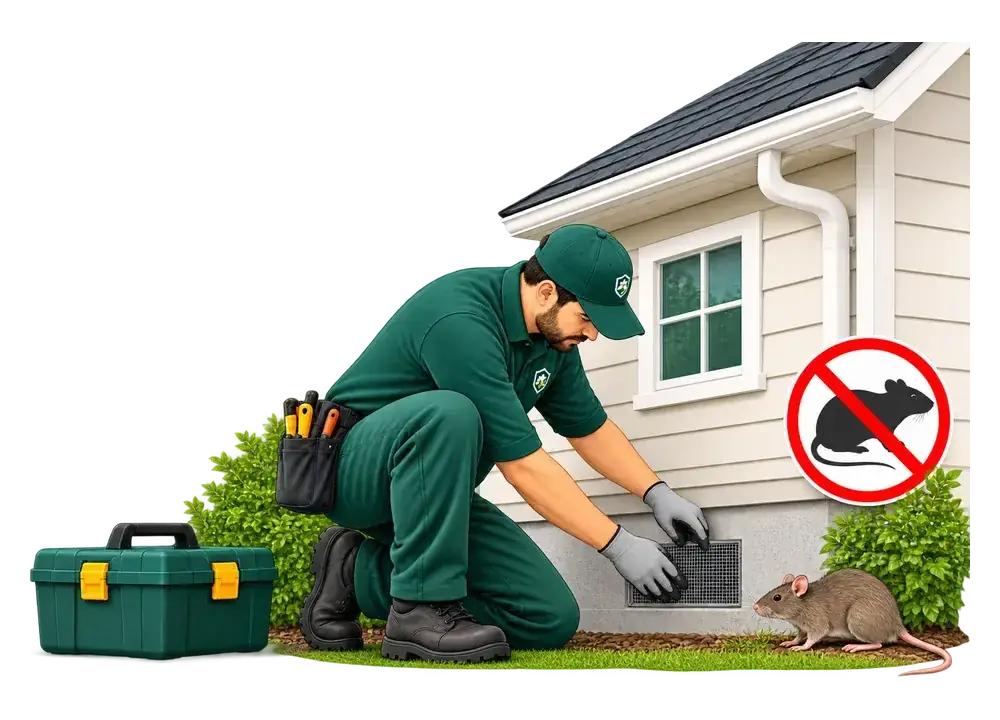
- Species check
- Roof rat or Norway rat
- Where to look
- Attic, burrows, roofline
- Method
- Devices along runways and nests
- Timing
- Often more than one visit
Key points
What to know first
Identify the species
Roof rats and Norway rats need different plans.
Check the roofline
Attics, trees, and overhangs are common roof rat routes.
Place devices with patience
Rats are cautious, so devices are placed with care.
Clean up afterward
Droppings and nests are removed safely.
Signs that a rat problem is growing
Rat activity tends to build slowly and then become obvious. Early signs include a few droppings near food storage, grease marks along a fence line, or a faint noise in the attic that stops when someone walks upstairs.
Later signs include gnawed fruit or pet food, droppings in several rooms, and a stronger odor in the garage, crawlspace, or shed.
Rats also leave evidence outside. Look for worn runways along the base of fences, tunnels beneath sheds or decks, and holes dug at the edge of a foundation.
Rats often travel the same paths night after night, and those paths can be traced by smudges, flattened vegetation, and gnawed edges around openings.
If you notice these signs, do not wait for the problem to become visible. Rats reproduce quickly, and an early inspection is usually simpler and less costly than dealing with a large established colony.
Roof rats and Norway rats: how to tell them apart
The two most common rat species in this area behave differently, so the plan depends on which one is present. Roof rats are slender, with large ears, a long tail, and a pointed snout.
They climb well and prefer upper areas such as attics, the tops of walls, trees, and overhanging branches. Norway rats are heavier and stockier, with a shorter tail, small ears, and a blunt nose.
They prefer to stay low, living in burrows, crawlspaces, sheds, and drainage areas.
Droppings can also help. Roof rat droppings are often smaller and pointed at the ends, while Norway rat droppings are larger and blunt.
These clues are not always conclusive, so the technician confirms the species during the inspection by looking at activity locations, travel routes, and the animals themselves when they are seen.
Knowing the species matters because it changes where the traps go. A roof rat job focuses on the roofline, attic, and tree contact points.
A Norway rat job focuses on ground-level burrows, foundations, and outbuildings. Many properties have both, and the company will plan for each.
Where rats nest on a property
Rats nest in places that are warm, quiet, and close to food. Attics are common for roof rats, especially where insulation is loose and stored items are rarely moved.
Wall voids, behind kitchen appliances, and inside soffits also provide cover. Norway rats often dig burrows beneath concrete slabs, under sheds, along fence lines, and in piles of debris.
Woodpiles, stacked lumber, dense shrubs, and compost bins give rats both shelter and a food supply. A woodpile against the house can serve as a bridge from the yard to the attic.
Moving these materials away from the structure is one of the simplest ways to reduce pressure on a home, and the inspection will identify which items need attention first.
Because nests are often hidden, the inspection includes areas that people rarely enter. Technicians may look in crawlspaces, roof spaces, and the back of storage areas, and they check for fresh gnawing, nesting material, and droppings in those locations.
How the inspection maps rat activity
The exterior is often the most revealing part of a rat inspection. Technicians walk the property looking for runways, burrows, gnaw marks on fence boards, and damage around vents and utility lines.
They also check trees and limbs that touch the roof, since those contact points give roof rats a direct route to the upper structure.
Inside, the focus is on attics, crawlspaces, garages, and food storage areas. Technicians note where they find droppings, rub marks, and nesting material, and they check for openings around pipes, wires, and ducts.
These observations are used to decide where traps and devices are placed and where sealing is needed.
The result is a written map, or a clear summary, that shows the main travel routes and the likely nest sites. You should be able to see what the company found and why it recommends certain steps before any work starts.
Trapping and devices for rats
Rats are cautious around new objects, so they may ignore a trap placed in an unfamiliar spot for several days. Experienced technicians plan for this.
They may leave devices unset for a short period, use a food attractant without a trigger, or place traps along a route rats already use. Patience is part of a good rat plan, and a company that rushes the process may miss important activity.
Traps and bait stations are placed along walls and runways, near nests, and at entry points. Bait stations are secured where possible, and their placement is chosen to keep them away from pets and children.
The company should explain how each device works, how often it is checked, and when it will be removed.
Some rat jobs use both traps and monitoring stations. Monitoring stations show whether activity is continuing without requiring a trap to be set.
When the monitoring shows no new activity for a period, the company can plan the final steps with more confidence.
Sealing and repairs after the animals are removed
Rats can gnaw through many common building materials, including soft wood, thin vinyl, and foam. Effective repairs use metal mesh, steel wool with a durable filler, and hardware cloth over vents and openings.
Openings about half an inch wide are large enough for an adult rat to use, so the sealing work focuses on any gap of that size or larger.
Doors and garage bays need a snug seal at the bottom, and vents need screening that blocks rats without restricting airflow. Gaps around pipes, cables, and air-conditioner lines should be closed with materials designed for that purpose.
The company will prioritize repairs based on the routes found during the inspection.
Some repairs require access to roof lines, soffits, or crawlspaces. If the repairs involve structural work, the company will say so and explain what is needed.
Our rodent exclusion service covers the sealing work in more detail.
Sanitation, health, and safety
Rats can carry germs, and their droppings and urine can contaminate surfaces, food, and stored materials. When cleaning up, ventilate the area, wear rubber gloves and a mask, and avoid stirring up dust.
Spray droppings with a disinfectant, let it soak briefly, and wipe with paper towels. Do not dry sweep or vacuum droppings directly.
Do not handle dead rats with bare hands. Use gloves and a bag, and follow local rules for disposal.
Nesting material that is contaminated should also be removed carefully. Our rodent cleanup service covers the removal of droppings and nesting material, and the sanitizing that follows.
Pets and children should stay away from work areas during treatment and cleanup. Ask the company about its safety plan before the first visit, and follow any instructions it gives about ventilation, access, and reentry.
Rat control for multi-unit and business properties
Apartment buildings, restaurants, and warehouses often face rat problems that spread between units or areas. A problem in one unit can move to neighboring spaces through shared walls, pipe chases, and drainage.
For these properties, the inspection looks at the whole building, and the plan includes coordination with the property manager or owner.
Commercial work typically includes scheduled visits, documented findings, and a plan that fits the property's operating schedule. Food-service areas need extra attention, because rats are drawn to food waste and stored supplies.
Our commercial rodent control service describes how that work is organized.
Questions about rat control
Can rats cause damage beyond droppings?
Yes. Rats gnaw on wiring, pipes, insulation, and stored goods. Chewed electrical wires are a fire risk, so any damage near wiring should be checked by a qualified electrician.
Why does the rat job take longer than a mouse job?
Rats are more cautious and often need several visits to find activity, set devices, and confirm the problem has stopped. The company will explain its timeline after the inspection.
Do I need to block all the holes myself?
No. Sealing should be done by the company or a qualified contractor, using the right materials and the right size for each gap. Your role is to keep food and trash secured and to report new signs.
What if I see a rat during the day?
A daytime sighting can mean a large number of animals are present, because rats are mostly active at night. Call the company promptly so it can check the most likely routes and plan an earlier visit.
Will rats return after the job?
They can, especially if a food source remains or a new opening appears. A follow-up check is part of a sound plan, and the company should review its findings if activity returns.
Next steps
If you have seen droppings near food, heard noises in the attic, or noticed gnawed material, call us at 555-555-555 or request a callback. Describe what you have seen and where.
We will connect you with a local company, and you can ask it about its species check and monitoring plan before you agree to work.
You can also read how the whole process works on our main Biloxi overview. If you are not sure whether you have mice, rats, or both, the inspection will clarify the situation before any plan is chosen.